What is cloud computing?

Cloud computing is a type of computing that relies on sharing computing resources rather than having local servers or personal devices to handle applications.

Service Models of Cloud Computing

Service delivery in Cloud Computing comprises three different service models, namely Infrastructure as a Service (IaaS), Platform as a Service (PaaS), and Software as a Service (SaaS). The three service models or layer are completed by an end user layer that encapsulates the end user perspective on cloud services.

Deployment Models of cloud computing

Cloud services can be deployed in different ways, depending on the organizational structure and the provisioning location. Four deployment models are usually distinguished, namely public, private, community and hybrid cloud service usage.

This is default featured slide 4 title

Go to Blogger edit html and find these sentences.Now replace these sentences with your own descriptions.

This is default featured slide 5 title

Go to Blogger edit html and find these sentences.Now replace these sentences with your own descriptions.

lunes, 8 de septiembre de 2014

What are deployment models in cloud computing?

In my third class of cloud computing we learn about the deployment Models of cloud computing, the cloud is an approach that harnesses the power of servers, as well as virtualization technologies that combine servers into large computing pools and divide single servers into multiple virtual machines. And there are several different deployment models for implementing cloud technology.  

The four primary types of cloud models are:

Public
Private
Hybrid
Community

Private cloud.
The cloud infrastructure is provisioned for exclusive use by a single organization comprising multiple consumers . It may be owned, managed, and operated by the organization, a third party, or some combination of them, and it may exist on or off premises.
Community cloud.
 The cloud infrastructure is provisioned for exclusive use by a specific community of consumers from organizations that have shared concerns . It may be owned, managed, and operated by one or more of the organizations in the community, a third party, or some combination of them, and it may exist on or off premises.
Public cloud.
The cloud infrastructure is provisioned for open use by the general public. It may be owned, managed, and operated by a business, academic, or government organization, or some combination of them.  It exists on the premises of the cloud provider.
Hybrid cloud.
The cloud infrastructure is a composition of two or more distinct cloud infrastructures (private, community, or public) that remain unique entities, but are bound together by standardized or proprietary technology that enables data and application portability.


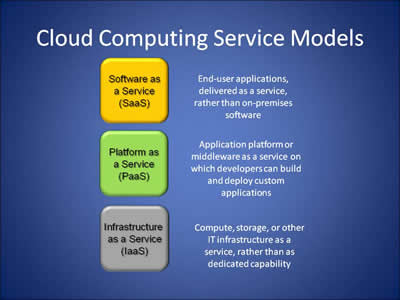
service models of cloud computing

In my second class of cloud computing we learn about the service models of cloud computing, the
software as a Service . The capability provided to the consumer is to use the provider’s applications running on a cloud infrastructure. The applications are accessible from various client devices through either a thin client interface, such as a web browser , or a program interface. The consumer does not manage or control the underlying cloud infrastructure including network, servers, operating systems, storage, or even individual application capabilities, with the possible exception of limited user- specific application configuration settings. Platform as a Service . The capability provided to the consumer is to deploy onto the cloud infrastructure consumer-created or acquired applications created using programming languages, libraries, services, and tools supported by the provider.The consumer does not manage or control the underlying cloud infrastructure including network, servers, operating systems, or storage, but has control over the deployed applications and possibly configuration settings for the application-hosting environment. Infrastructure as a Service .The capability provided to the consumer is to provision processing, storage, networks, and other fundamental computing resources where the consumer is able to deploy and run arbitrary software, which can include operating systems and applications. The consumer does not manage or control the underlying cloud infrastructure but has control over operating systems, storage, and deployed applications; and possibly limited control of select networking components .


viernes, 29 de agosto de 2014

What is cloud computing?

In my first english class we learning about the cloud computing, but... what is cloud computing?


Cloud computing is the delivery of computing as a service rather than a product,
 where by shared resources, software, and information are provided to computers
 and other devices as a utility over a network (typically the Internet). Clouds can be classified as public, private or hybrid.

The idea of an "intergalactic computer network" was introduced in the sixties by J.C.R. Licklider, his vision was for everyone on the globe to be interconnected and accessing programs and data at any site, from anywhere, explained Margaret Lewis, product marketing director at AMD.
Other experts attribute the cloud concept to computer scientist John McCarthy who proposed the idea of computation being delivered as a public utility, similar to the service bureaus which date back to the sixties.

well in simple terms wherever you go, your data goes with you. I am not talking about the physical device(for example a pen drive) that you carry. All your data is basically stored in company’s Hard Disk Drive at a completely different location(another country), and that data can be accessed from anywhere in the world, with an internet connection.